
The PSMAddition Trial Showed Longer Life Without Progression Is Possible With PLUVICTO. That's Victory.
PLUVICTO + androgen receptor pathway inhibitor (ARPI) was studied against a comparator arm of ARPI in the PSMAddition trial.1
Primary end point
Radiographic Progression-Free Survival
PSMAddition: A study of PLUVICTO in mAPMN/S PC (mHSPC)
rPFS: In the primary analysis, PLUVICTO + ARPI significantly decreased the risk of radiographic progression or death vs ARPI1
Median rPFS was not reached in either arm (HR=0.72 [95% CI, 0.58-0.90; P=0.002)1
In the final analysis
PLUVICTO + ARPI reduced the risk of radiographic progression or death2
Median rPFS was not reached in the PLUVICTO + ARPI arm vs 48.5 months (95% CI, 40.5-NE) in the ARPI arm
RADIOGRAPHIC PROGRESSION-FREE SURVIVAL

Final rPFS analysis was performed with a median follow-up period of 37.7 months vs the primary analysis at 23.6 months. This analysis was not controlled for Type-I error2,3
rPFS benefit was consistent across subgroups2,*
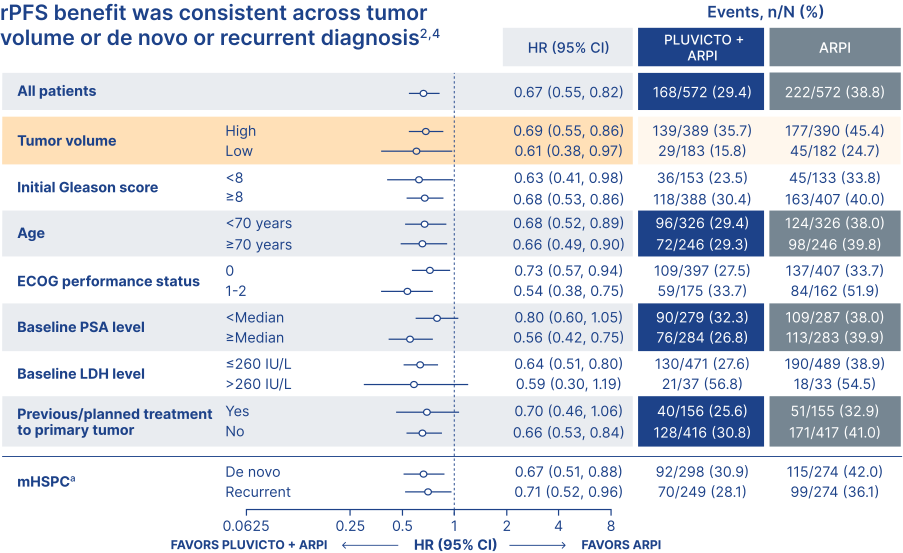
ECOG, Eastern Cooperative Oncology Group Performance Status; HR, hazard ratio; LDH, lactate dehydrogenase; mAPMN/S PC, metastatic androgen pathway modulation-naive or -sensitive prostate cancer; mHSPC, metastatic hormone-sensitive prostate cancer; NE, not estimable; PSA, prostate-specific antigen; rPFS, radiographic progression-free survival.
*Subgroup analyses are exploratory and not powered for statistical significance.
aNot a prespecified patient population and analyzed separately from other subgroup data. De novo included stage IVb at diagnosis. Recurrent included stages IVa, IV, and below IV at diagnosis.3
Key secondary end point
Overall survival (OS) analysis in the PSMAddition trial
OS: Numerically favored PLUVICTO
OS data were still maturing, and statistical significance was not reached at interim analysis 2 (IA2)
HR was 0.84 (95% CI, 0.63-1.13) at IA1 (median follow-up of 23.6 months)3,†
HR decreased to 0.80 (95% CI, 0.63-1.01) at IA2 (median follow-up of 37.7 months)2,‡
Median OS was not reached in either arm2,3
OVERALL SURVIVAL2,a

IA1, interim analysis 1.
†Data cutoff for IA1 was January 13, 2025, with a total of 184 events occurring across both study arms; 16% of patients randomized to the ARPI arm subsequently crossed over to receive PLUVICTO following confirmed radiographic progression.3
‡Data cutoff for IA2 was March 17, 2026, with a total of 291 events occurring across both study arms. Data are from an unadjusted OS analysis that did not account for crossover. 21% of patients randomized to the ARPI arm subsequently crossed over to receive PLUVICTO following confirmed radiographic progression.2
aData are from IA2.
Additional End Points
Nearly 9 out of 10 patients treated with PLUVICTO + ARPI achieved undetectable PSA2,*
PSA nadir <0.2 ng/mL at 48 weeks2:

*PSA nadir (<0.2 ng/mL).
†Not powered for statistical significance.
6 in 10 patients achieved complete responses with PLUVICTO + ARPI†
In the final analysis
ORR (CR + PR): Higher ORR achieved with PLUVICTO + ARPI vs ARPI2,‡

Responses are based on soft tissue and bone lesion assessment.
†Not powered for statistical significance.
‡By BICR per PCWG3-modified RECIST v1.1 criteria.
- Median DOR was not reached with PLUVICTO + ARPI (95% CI, NR-NR) vs 42.55 with ARPI (95% CI, 33.12-NR)4
BICR, Blinded Independent Central Review; PCWG3, Prostate Cancer Working Group 3; RECIST, Response Evaluation Criteria in Solid Tumors.
Overall response rate (ORR) is the percentage of patients who had a complete response (CR) or partial response (PR) at any point after the start of the study treatment until the end of treatment.5
CR is the disappearance of all target lesions. Any pathological lymph nodes (target or nontarget) must have reduction in short axis to <10 mm.5
PR is at least a 30% decrease in the sum of diameters of target lesions, taking as reference the baseline sum diameters.5
60% risk reduction in time to PSA progression with PLUVICTO + ARPI vs ARPI2,†
Time to PSA progression: Median time to PSA progression was not reached with PLUVICTO + ARPI (NE-NE) vs not reached with ARPI (NE-NE)2
TIME TO PSA PROGRESSION2
![Time to PSA progression: 60% risk reduction of time to PSA progression (HR=0.40 [95% CI, 0.30-0.54])](https://usim.beprod.pluvicto-hcp.com/sites/pluvicto_hcp_com/files/2026-06/3.0_pluvicto-time-to-psa-progression-mobile.svg)
†Not powered for statistical significance.
Progression to mAPMR PC (mCRPC) was delayed for longer with PLUVICTO + ARPI vs ARPI2,†
Time to castration resistance: Median time to castration resistance was 47.9 months with PLUVICTO + ARPI (40.9-NE) vs 29.6 months with ARPI (25.3-36.6)2,‡
TIME TO CASTRATION RESISTANCE2
![Time to castraction resistance: 30% Risk reduction of time of castraction resistance (HR=0.70[95% CI, 0.59-0.83])](https://usim.beprod.pluvicto-hcp.com/sites/pluvicto_hcp_com/files/2026-06/3.0_pluvicto-time-to-development-of-mcrpc-mobile_0.svg)
mAPMR PC, metastatic androgen pathway modulation-resistant prostate cancer; mCRPC, metastatic castration-resistant prostate cancer.
†Not powered for statistical significance.
‡Time to castration resistance (TTCR) events included rise in serum PSA levels, progression of pre-existing disease, and appearance of new metastases.3
Multidisciplinary Perspectives on PLUVICTO Across the Metastatic APMS and APMR Prostate Cancer Continuum
Patient-Reported Outcomes
Final analysis: Median time to worsening of HRQOL4

Longitudinal assessment in change from baseline4
FACT-P TOTAL SCORE

The FACT-P total score is the sum of the scores of 39 items of the questionnaire and ranges from 1 to 156, with higher scores indicating better quality of life. FACT-P measures physical well-being, social/family well-being, emotional well-being, functional well-being, and prostate cancer subscale6
Time to worsening of FACT-P total score was a prespecified, nonpowered, secondary exploratory end point and not statistically significant
PRO questionnaires were collected every 6 weeks through week 36, then every 12 weeks thereafter4
Longitudinal analyses are descriptive, based purely on patient questionnaire responses, and include all available assessments; post-progression questionnaires may continue to be collected
85.6% of patients received all 6 doses of PLUVICTO3
Final analysis: Median time to worsening of HRQOL4

Longitudinal assessment in change from baseline4
BPI-SF PAIN INTENSITY

BPI-SF assessed the severity of patients' pain and its impact on daily function through a 13-question form, with scores ranging from 0 to 10 and lower scores representing lower levels of pain intensity. BPI-SF measures pain intensity (worst, least, average, current), pain relief, and interference of pain6
Time to worsening of BPI-SF was a prespecified, nonpowered, secondary exploratory end point and not statistically significant
PRO questionnaires were collected every 6 weeks through week 36, then every 12 weeks thereafter4
Longitudinal analyses are descriptive, based purely on patient questionnaire responses, and include all available assessments; post-progression questionnaires may continue to be collected
85.6% of patients received all 6 doses of PLUVICTO3
BPI-SF, Brief Pain Inventory—Short Form; FACT-P, Functional Assessment of Cancer Therapy—Prostate; HRQOL, health-related quality of life; LS, least squares; PRO, patient-reported outcome.
Trial Design
PSMAddition: FIRST POSITIVE TRIAL vs ARPI IN THE MAJORITY OF PATIENTS WITH mHSPC1
THIS RANDOMIZED, MULTICENTER, OPEN-LABEL, ACTIVE-CONTROLLED STUDY COMPARED PLUVICTO + ARPI vs ARPI1
![Select inclusion criteria (N= 1144): High or low-volume disease. ECOG 0-2. PSMA+ disease (at least 1 PSMA+ lesion [soft tissue or bone] with gallium Ga 68 gozetotide uptake greater than normal liver). Treatment naive or minimally treated. Randomized 1:1. PLUVICTO + APRI (n=572); ARPI (n=572)](https://usim.beprod.pluvicto-hcp.com/sites/pluvicto_hcp_com/files/2026-06/3.3_psmaforeaddition-study.svg)
Primary end point: rPFS1,3
Key secondary end point: OS1,3
Select additional end points: Undetectable PSA,† ORR, time to PSA progression, time to castration resistance1,3
In both arms, patients received treatment with abiraterone (n=424), apalutamide (n=372), enzalutamide (n=250), darolutamide (n=68), or another ARPI (n=12)1
Patients received a gonadotropin-releasing hormone (GnRH) agonist or antagonist concurrently or had a bilateral orchiectomy1
Patients in the ARPI arm were permitted to cross over to receive PLUVICTO upon centrally reviewed radiographic progression3
After discontinuing PLUVICTO + ARPI, patients (n=173) went on to receive subsequent therapy–76.3% received hormonal therapy, 49.7% received chemotherapy, 11.5% received targeted therapy, and 5.2% received biologic therapy4
PSMA+, prostate-specific membrane antigen positive.
*No systemic treatment was allowed, apart from ADT in the neo-/adjuvant setting and/or up to 45 days of ADT, ARPI, or both in the metastatic setting prior to consent.1
†PSA nadir (<0.2 ng/mL).
PSMAddition evaluated a broad patient population reflective of clinical practice1,3
PSMAddition enrolled 1144 patients with PSMA+ mHSPC1
CLINICAL INDICATORS | PLUVICTO + ARPI | ARPI | |
Tumor volume, n (%) | 389 (68) 183 (32) | 390 (68.2) 182 (31.8) | |
| High volumea Low volume | ||
mHSPC, n (%) | 298 (52.1) 249 (43.5) 25 (4.4) | 274 (47.9) 274 (47.9) 24 (4.2) | |
| De novob Recurrentc Missing | ||
Gleason score, n (%) | 152 (26.6) 389 (68) | 134 (23.4) 406 (71) | |
| <8 ≥8 | ||
Site of disease, n (%) | 522 (91.3) 202 (35.3) 66 (11.5) 11 (1.9) | 521 (91.1) 192 (33.6) 83 (14.5) 21 (3.7) | |
| Bone Lymph node Lung Liver | ||
Median age, y (range) | 68 (38-91) | 68 (36-90) | |
ECOG performance status, n (%) | 397 (69.4) 175 (30.6) | 407 (71.2) 162 (28.3) | |
| 0 1-2 | ||
PSA, median (ng/mL) | 12.06 | 11.64 | |
De novo and recurrent were determined based on stage at initial diagnosis (AJCC Cancer Staging Manual 8th edition)3:
- De novo: Stage IVb
- Recurrent: Stage <IV, IV, and IVa
aHigh tumor volume was defined as visceral metastases and/or ≥4 bone lesions with ≥1 lesion beyond the vertebral bodies and pelvis.3
bDe novo included stage IVb (52.1% PLUVICTO + ARPI and 47.9% ARPI).3
cRecurrent included stage IVa (3% PLUVICTO + ARPI and 2.6% ARPI), stage IV (20.6% PLUVICTO + ARPI and 22.7% ARPI) and stages below IV (19.9% PLUVICTO + ARPI and 22.6% ARPI).3
PSMAddition included patients regardless of tumor volume1